

C: Radar Sensor#
This example populates an ovstage instance from radar_example.usda,
attaches it to the renderer, renders a radar PointCloud output through
ovrtx_step_with_stage, maps the composite render variable to CPU memory,
and reads the named tensor channels. ovstage owns scene ingest and stepping;
sensor output fetch/map stays a renderer-side concern on the ovrtx APIs. The
moving target approaches the radar, so its RadialVelocityMs values are
expected to be negative.
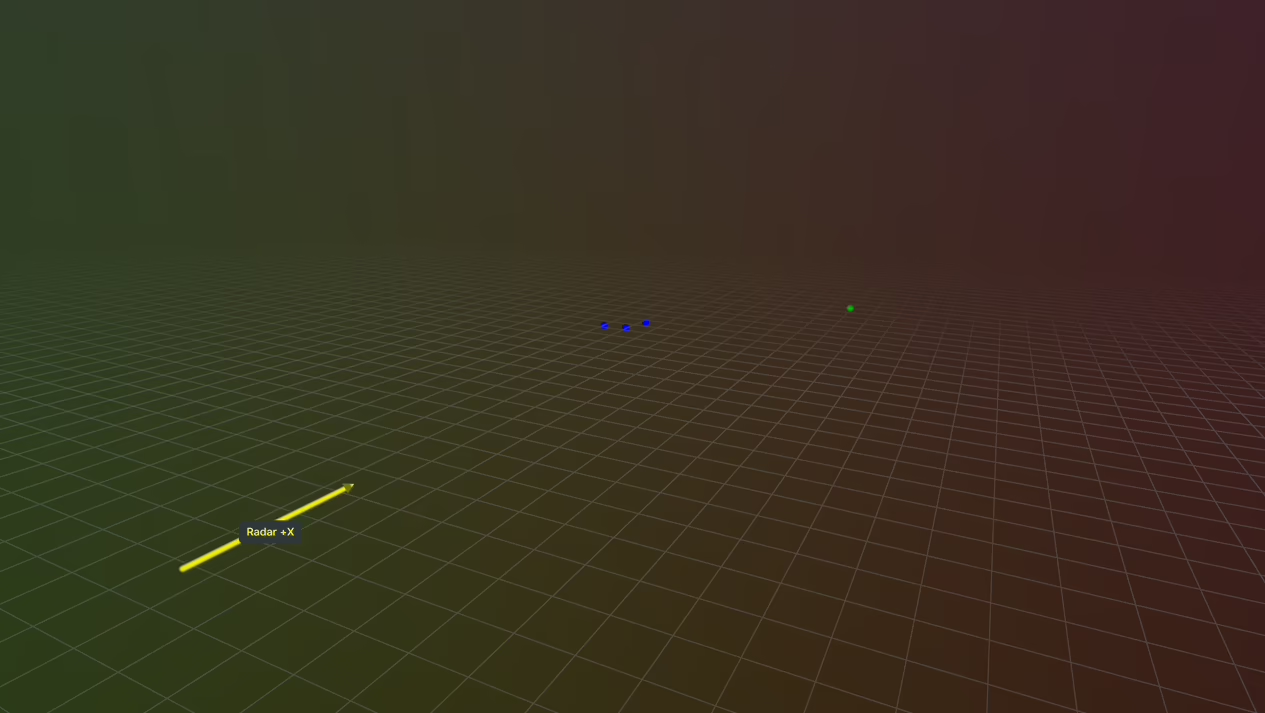
The scene is Z-up and contains a radar at (0, 0, 1) rotated to look along
world +X, an asphalt ground plane, a moving steel cube, and a fixed concrete
cube. The USD requests Coordinates, Counts, RCS, and
RadialVelocityMs channels.
The executable enables MotionBVH through ovrtx_config_t at renderer
creation because it is required for moving-object radial velocity.
“Create a C/C++ radar sensor example that configures the renderer for sensor output, loads an animated radar scene, advances scene time across several simulation steps, reads valid detection data including signal strength and signed radial velocity, prints per-step summaries, reports moving-target observations, and cleans up all resources.”
Build and Run#
Prerequisites
sudo apt install build-essential cmake
Building
cd examples/c/radar
cmake -S . -B build -DCMAKE_BUILD_TYPE=Release
cmake --build build
Running
./build/radar-composite-tensor
You can also pass an explicit scene path:
./build/radar-composite-tensor path/to/radar_example.usda
Prerequisites
Building
cd examples/c/radar
cmake -S . -B build
cmake --build build --config Release
Running
.\build\Release\radar-composite-tensor.exe
Expected output values vary, but a successful run prints 10 steps and a final observation line summarizing detections with nonzero radial velocity.