

Python: Debug Views#
This example renders RT2 G-buffer and heat map debug views from the robot-lineup scene.
It captures each view before logging all images together to Rerun under their
debug-view selector names. Static views are captured first, then the robots move
for ten frames to capture targetMotion and targetMotionArrows.
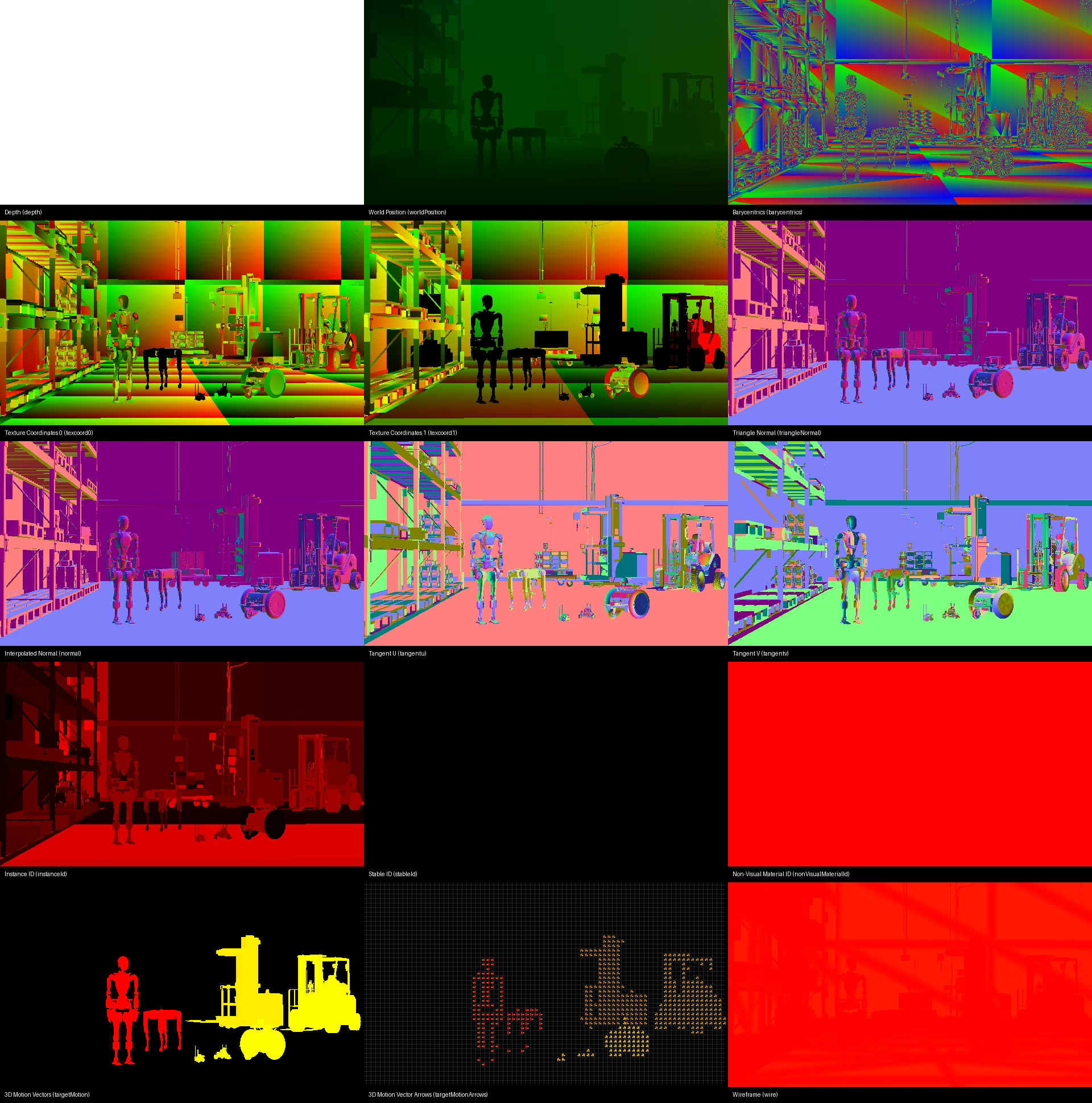
The RT2 G-buffer debug views rendered from one scene. Each tile is named after the selector authored on its RenderProduct.#
The example creates one RenderProduct per selector. Every RenderProduct requests only LdrColor and HdrColor.
The rendering loop below captures the HdrColor output for each RenderProduct. It converts the display-encoded debug views to 8-bit without tonemapping.
images = {}
for label, selector in DEBUG_VIEWS:
    render_product_path = f"/Render/{selector}"
    print(f"Rendering {label} ({selector})...")

    products = None
    # Each RenderProduct has independent temporal state, so warm it up before capture.
    for _ in range(max(args.warmup_frames, 0) + 1):
        products = renderer.step(
            render_products={render_product_path},
            delta_time=args.step_dt,
            ordinal=ordinal,
        )

    if not products[render_product_path].frames:
        raise RuntimeError(f"{render_product_path} did not produce an image")

    frame = products[render_product_path].frames[0]
    # Debug views already contain display colors; copy them without HDR tonemapping.
    pixels = _map_hdr_debug_view(frame, render_product_path)
    images[selector] = _to_uint8(pixels)
    del frame, products

# Capture motion views after all static views so movement cannot change their images.
motion_selectors = ("targetMotion", "targetMotionArrows")
robot_paths = [
    "/World/GR1T2_fourier_hand_6dof", "/World/spot", "/World/forklift_c", "/World/forklift_b",
    "/World/carter_v1", "/World/jetbot", "/World/kaya",
]
velocities = np.array(
    [(3, 0, 0), (-3, 0, 0), (2, 0, 1), (-2, 0, 1), (3, 0, 1), (-3, 0, 1), (2, 0, 1)],
    dtype=np.float64,
)
with ovstage.PathDictionary(stage) as paths:
    path_list = paths.create_path_list_from_strings(robot_paths)
    with stage.query_from_path_list(path_list) as query:
        attribute = paths.intern_token("omni:xform")
        transforms = np.full((len(robot_paths), 4, 4), np.nan, dtype=np.float64)
        # Preserve orientation and scale, including the centimetre-scaled forklift payload.
        with stage.read_attributes(query, [attribute], ovstage.OrdinalRange.latest(ordinal)) as read:
            while (group := read.fetch_next()) is not None:
                values = np.from_dlpack(group.dlpack(0)).reshape(-1, 4, 4)
                for index in range(group.prim_count):
                    transforms[group.prim_index(index)] = values[group.data_row_index(index)]
                del values
                stage.release_group(group)
        if not np.all(np.isfinite(transforms)):
            raise RuntimeError("Motion views require transforms for all seven lineup robots")

        matrix_dtype = ovstage.numpy_to_dldatatype(transforms.dtype, lanes=16)
        for selector in motion_selectors:
            render_product_path = f"/Render/{selector}"
            # Refresh previous-frame transforms after the other views' independent warmups.
            for _ in range(2):
                products = renderer.step(
                    render_products={render_product_path}, delta_time=args.step_dt, ordinal=ordinal
                )
                del products

            for motion_step in range(10):
                # Alternate small offsets to keep robots in view while providing motion every frame.
                direction = 1.0 if motion_step % 2 == 0 else -1.0
                transforms[:, 3, :3] += direction * velocities * args.step_dt
                ordinal += 1
                tensor = ovstage.make_dltensor(transforms, dtype=matrix_dtype, shape=[len(robot_paths)], ndim=1)
                stage.write_attribute(query, attribute, ordinal=ordinal, tensors=tensor, is_array=False).wait()
                stage.advance_write_floor(ordinal, ovstage.Scope.ALL).wait()
                products = renderer.step(
                    render_products={render_product_path}, delta_time=args.step_dt, ordinal=ordinal
                )
                if motion_step < 9:
                    del products

            if not products[render_product_path].frames:
                raise RuntimeError(f"{render_product_path} did not produce a moving frame")
            frame = products[render_product_path].frames[0]
            pixels = _map_hdr_debug_view(frame, render_product_path)
            display = _to_uint8(pixels)
            changed_pixels = np.count_nonzero(np.any(display != images[selector], axis=-1))
            print(f"Moving {selector}: {changed_pixels} pixels differ from static capture", flush=True)
            images[selector] = display
            del frame, products
    paths.destroy_path_list(path_list)
Run the example interactively, save a Rerun recording, or create PNG output:
cd examples/python/debug-views
uv run main.py
uv run main.py --rrd _output/debug-views.rrd
uv run main.py --no-rr --png _output/debug-views.png
See Outputs for the supported selectors and output-routing behavior.