

Work Across Render Products#
Goal. Read an AOV produced by a different RenderProduct, or drive several products in one step.
Before you start. Publish, Overwrite and Read Back AOVs.
The Shape#
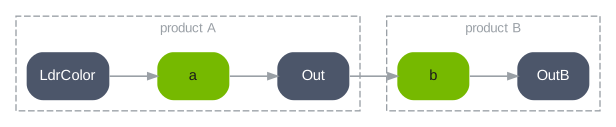
A node under one product can read an AOV published by another. Dashed boxes are RenderProducts.
A cross-product edge. B reads an AOV that A published.
A chain of three. Each product’s result feeds the next, so SPG orders all three.

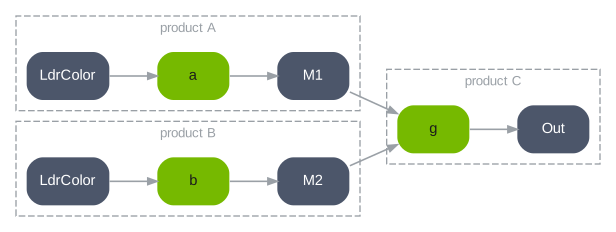
Two products into one node. g runs after both producers, wherever they live.
Independent products. No edge crosses, so nothing orders one against the other.
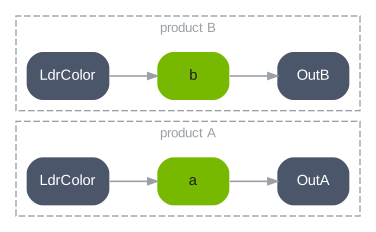
A graph is authored under a RenderProduct, and a scene may carry several. Each has its own camera and its own orderedVars, the list of AOVs it produces.
Inside one product, a node reads a RenderVar by a relative path. Across products, the same connection carries an absolute one, naming the product it comes from:
opaque inputs:Image.connect = <../LdrColor.omni:rtx:aov>            # this product
opaque inputs:Edges.connect = </Render/Camera/Edges.omni:rtx:aov>   # another product
How It Works#
Two products, and one edge between them. Camera renders the scene, runs a node over its
LdrColor and publishes the result as Edges. Overlay runs a second node that reads
that published AOV and publishes its own. Highlighted: the RenderVar that makes the result
readable outside its own product, and the connection that reaches it.
 def Scope "Render"
 {
     def RenderProduct "Camera"
     {
         uniform int2 resolution = (1280, 720)
         rel camera = </World/Camera>
         rel orderedVars = [ <LdrColor>, <Edges> ]

         def RenderVar "LdrColor"
         {
             uniform string sourceName = "LdrColor"
             opaque omni:rtx:aov
         }

         def RenderVar "Edges"
         {
             uniform string sourceName = "Edges"
             opaque omni:rtx:aov.connect = <../EdgeKernel.outputs:Edges>
         }

         def Shader "EdgeKernel" ( references = @EdgeKernel.usda@ )
         {
             opaque inputs:Image.connect = <../LdrColor.omni:rtx:aov>
         }
     }

     def RenderProduct "Overlay"
     {
         uniform int2 resolution = (1280, 720)
         rel camera = </World/OverlayCamera>
         rel orderedVars = [ <Composited> ]

         def RenderVar "Composited"
         {
             uniform string sourceName = "Composited"
             opaque omni:rtx:aov.connect = <../CompositeKernel.outputs:Result>
         }

         def Shader "CompositeKernel" ( references = @CompositeKernel.usda@ )
         {
             opaque inputs:Edges.connect = </Render/Camera/Edges.omni:rtx:aov>
         }
     }
 }
An intermediate has to be published to cross. Inside a product a node reads another node’s
outputs: port directly, and nothing else sees it. Across products there is no such edge: the
producing node’s result needs a RenderVar and a place in that product’s orderedVars before
anything outside can name it.
Each product needs its own camera, including one that only hosts nodes.
One step fills every product you ask for. Pass them together rather than stepping each in turn, so the frame is shared:
products = renderer.step(
    render_products={"/Render/Camera", "/Render/Overlay"},
    delta_time=STEP_DT,
    ordinal=ordinal,
)
Each product runs its own graphs. Nodes under a product see that product’s AOVs.
Reaching another node’s result is a choice between two edges with different costs. Inside one product, a direct connection is exact and same-frame; refer to Chain Nodes. Across products, the same dependency is carried by a RenderVar and can lag by a frame. If a result has to be current within the frame, that is an argument for keeping both nodes under one product, not for accepting the lag.
A node can read another product’s output. SPG orders the graphs so the producer runs first where it can.
A cross-product read can be one frame stale. When the consuming product renders before the producing one, the value read is the previous frame’s. It converges once the dependency has rendered. If a result must be current within the frame, keep both nodes under one product and chain them instead.
Verify It Worked#
Step both products, then compare the consumer’s output against the producer’s for the same frame. A one-frame lag shows as the consumer trailing by exactly one step when something in the scene moves.
When It Goes Wrong#
Refer to Something Is Stale or Late.