

Cameras#
A camera renders color images and scene data from a USD Camera prim. A RenderProduct selects the camera, resolution and outputs to capture.
Camera outputs#
Camera outputs include a tone-mapped image for display and a linear HDR image for image processing and compositing. The same view can also produce surface normals, distances, motion, segmentation, bounding boxes and object identifiers. Camera Outputs lists the available outputs, their formats and units; Decoding camera outputs shows how to request and read them in Python and C.
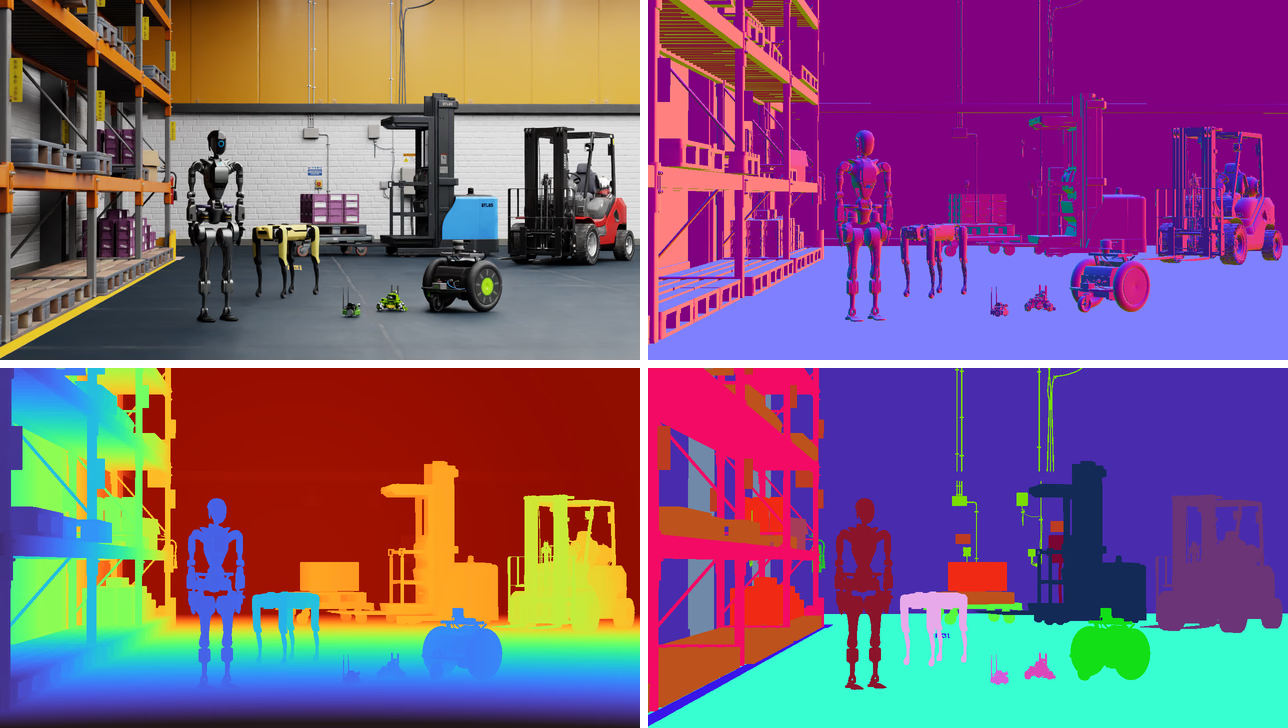
Color (top left), surface normals (top right), distance to the camera (bottom left) and semantic segmentation (bottom right), from the same viewpoint.#
Render modes#
ovrtx provides three different modes, each targeting a different balance of throughput and fidelity. Render Modes describes Real-Time Path Tracing for path-traced lighting with real-time denoising, Path Tracing for accumulated reference images, and Minimal for higher throughput without path-traced lighting. Each RenderProduct selects its mode.
Path Tracing can separate lighting contributions into compositing passes using Light Path Expressions. Its spectral rendering option models wavelength-dependent light transport and camera spectral response.
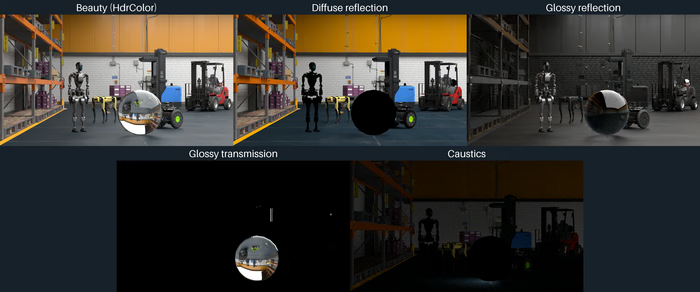
A Path Tracing image and four Light Path Expression passes: diffuse reflection, glossy reflection, glossy transmission and caustics.#
Camera attributes#
Camera attributes control projection, focus, clipping and exposure. Lens Calibration adds OpenCV pinhole and fisheye distortion, lookup-table projections and omni-directional stereo.
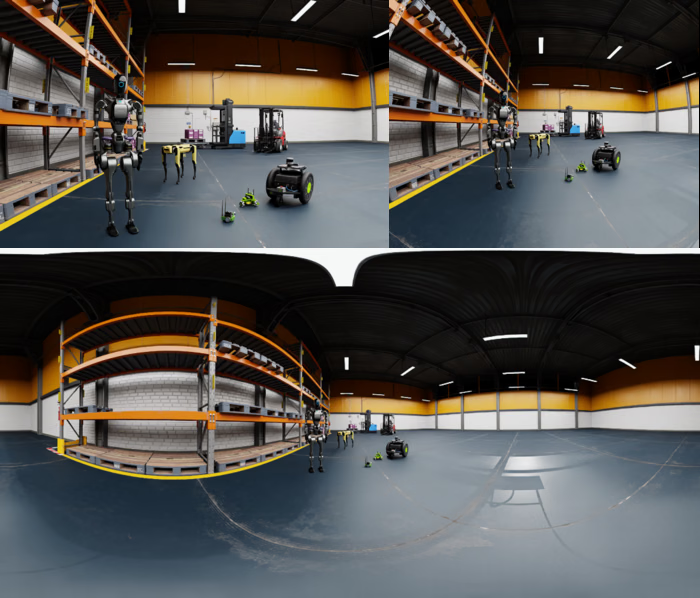
The same scene with OpenCV pinhole, OpenCV fisheye and omni-directional stereo projections (clockwise from top left).#
Rolling Shutter samples rows or columns at different times, producing skew when the camera or scene moves. Sensor Scheduling schedules cameras at different capture rates. Scene Partitions lets cameras render isolated environments within one stage.
Sensor modeling#
The Camera generic core model adds a color filter array, sensor noise, compression and image signal processing to rendered images. The Camera single-view stereo depth model produces depth images with disparity noise, quantization and missing measurements.
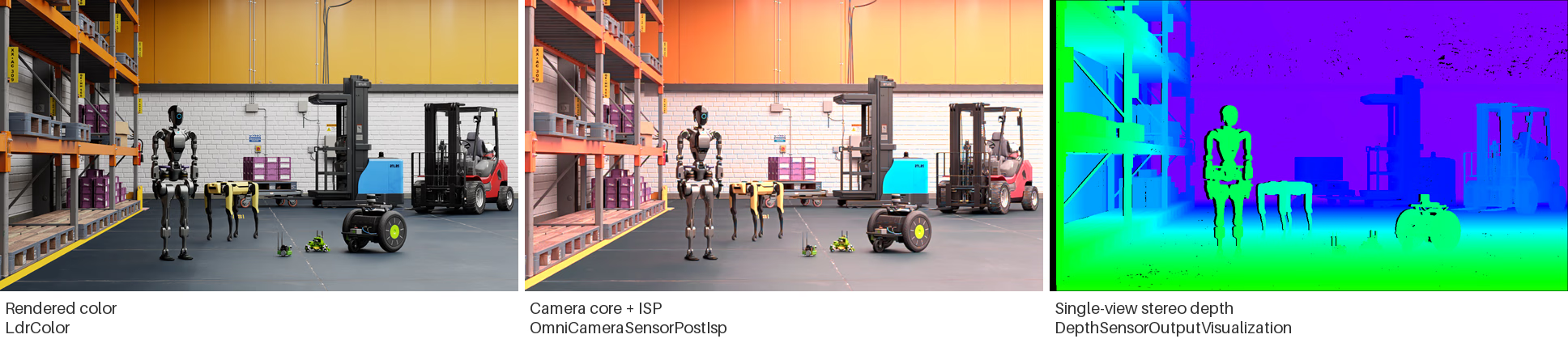
The robot lineup from three cameras at the same pose. Left: rendered
LdrColor. Center: OmniCameraSensorPostIsp with a sample camera
profile. Right: DepthSensorOutputVisualization, black where no
measurement is reported.#