

Visual Sensors#
This section describes two post-processing pipelines that simulate camera sensor outputs from renderer outputs. Each model reads AOVs from a RenderProduct and publishes its results on that same RenderProduct. The models that trace the scene to simulate non-visual measurements are under Non-Visual Sensors.
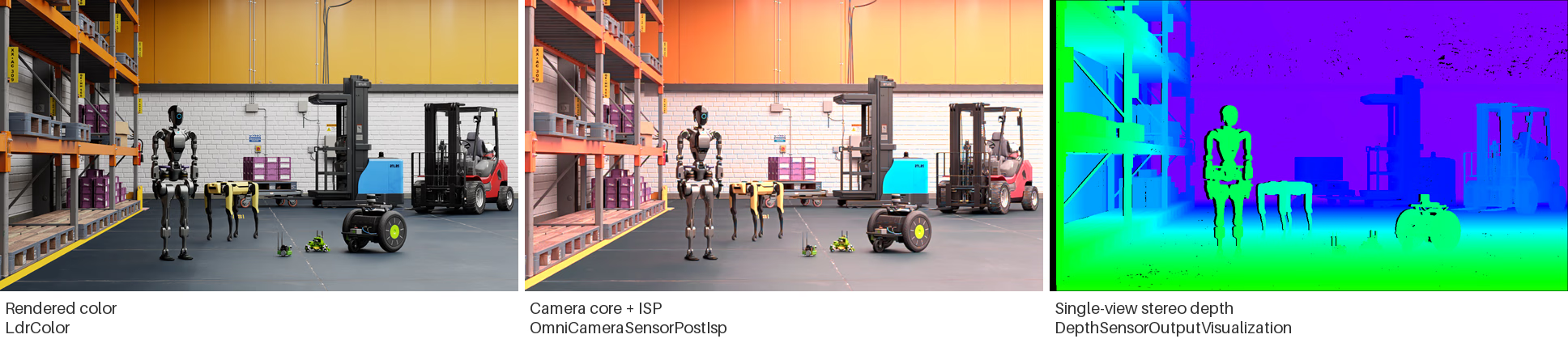
The robot lineup from three cameras at the same pose. Left: rendered
LdrColor. Center: OmniCameraSensorPostIsp with a sample camera
profile. Right: DepthSensorOutputVisualization, black where no
measurement is reported.#
The Cameras section and its
Outputs page describe the render modes and the AOVs
a camera product can deliver, such as
LdrColor, HdrColor, distance and segmentation. This section describes
post-processing of those AOVs. Each model’s Outputs page lists its required
inputs. Apply OmniSensorGenericCameraCoreAPI to the Camera prim for the
Camera generic core model, and OmniSensorGenericDepthSensorSingleViewAPI to
the Camera prim for the Camera single-view stereo depth model. Both models
use the existing camera and product prims. A camera carries one of the two
schemas, never both; requesting a model’s outputs on the camera’s RenderProduct
runs its pipeline, and the schema supplies the parameters.
Sensor Configuration states that rule
under Creating a sensor, and
Output Configuration how a RenderProduct
requests outputs.
Each model has a directory of its own below. Its overview says what the model simulates and in what vocabulary, where it begins relative to the rendered view and what it leaves to other parts of ovrtx; under it hang the USD attributes the model answers to, one how-to page per task, and an Outputs page that says what each output holds and which attributes shape it. Read the overview first, then the others as you need them.
The models#
The Camera generic core model, a Camera prim with
OmniSensorGenericCameraCoreAPI applied, is for consumers that expect frames
the way a camera sensor sends them, RAW or processed by an image signal
processor (ISP), rather than the renderer’s clean output. It delivers the image
at each stage of the sensor and ISP chain, so a perception stack or an ISP under
test can be fed from a simulated scene. Start with the
overview; its Outputs
page lists the outputs each stage publishes.
The Camera single-view stereo depth model, a Camera prim with
OmniSensorGenericDepthSensorSingleViewAPI applied, is for consumers that expect a
stereo depth camera’s output, with occlusion holes, disparity noise and
quantization. From one rendered view it delivers a depth image and a per-pixel
point cloud. The overview describes the model;
Outputs lists its outputs.
The two models are independent pipelines that can share one RenderProduct. Which camera outputs each one reads is stated on its own pages: Where the model begins for the Camera generic core model and Inputs for the Camera single-view stereo depth model.